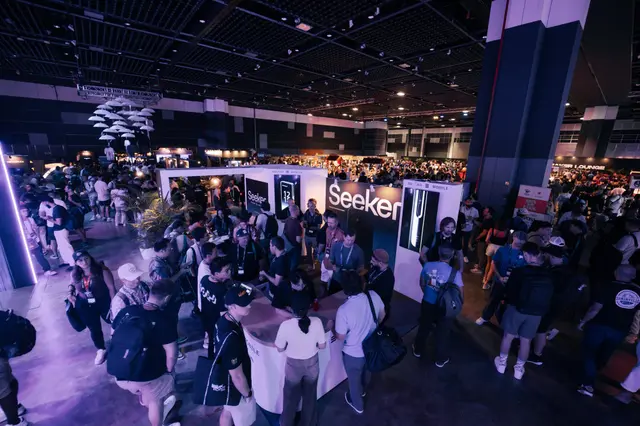
In late 2024, the Solana Foundation laid out an ambitious bet: scrap the panel-and-mixer conference playbook, refuse paid sponsorships, and build a calendar of product- and growth-focused events designed to make every flight, hotel, and day off worth the cost. Twelve months later, that strategy has produced measurable results — Breakpoint 2025 in Abu Dhabi drew over 7,200 attendees from 100+ countries, generated 75+ product announcements, and helped catalyze $650 billion in stablecoin transactions settled on Solana in February 2026 alone. This is the honest scorecard of what worked, what didn’t, and what it means for SOL holders watching the ecosystem from the outside.
SOL trades at $87.44 on May 6, 2026, with a $50.45 billion market cap (CoinGecko, rank #7). The chart looks weak. By contrast, the developer base, institutional integrations, and global reach the events strategy was designed to build have all expanded measurably — exactly the kind of fundamental compounding that price tends to recognize late, not early.
The 2024 Strategy: A Quick Recap
The original “Gather to Build” framework rested on four principles. First, sharp focus on product — supporting founders building apps and tokenizing assets, not generic blockchain advocacy. Second, side events over sponsorships — the Foundation explicitly committed to stop paying for logos on conference walls and instead host its own gatherings. Third, integrate community events — co-program with ecosystem teams rather than competing with them. Fourth, a barbell format — small, niche events for specialists (DePIN teams, product designers) and XL events for the whole ecosystem.
Therefore, the test wasn’t whether Solana could fill ballrooms — every Layer-1 can do that during a bull cycle. The test was whether the events would actually translate into product launches, institutional integrations, and developer retention through a market downturn. By that standard, 2025 delivered.
Scale or Die and Ship or Die: The New York Bet
The Foundation’s first big test was its New York doubleheader in May 2025. Scale or Die ran May 19–20 as a workshop-driven, application-only technical conference for developers, validators, engineers, PMs, and strategists. Ship or Die followed on May 22–23 as a larger, open-to-all event positioning the Solana ecosystem to the broader U.S. crypto industry.
The results validated the format. The combined “Solana Accelerate 2025” week became Solana’s largest-ever event held in the United States, breaking attendance records and getting described by the Foundation’s Dan Albert as “one of the most productive Solana gatherings to date.” More importantly, the event seeded a wave of follow-on community programming across U.S. cities — Skyline in New York, Onion Dow in Chicago, the Hub in Miami, and Mountain Dow in Utah. As a result, the Foundation’s bet that hosting was higher-leverage than sponsoring proved correct: the events created compounding ecosystem energy rather than one-shot brand exposure.
APEX: The Global Mega-Region Strategy
The original 2024 announcement promised APEX events across five mega-regions — Mexico City, Cape Town, Budapest, Singapore, and Mumbai. Each was designed as a focused, founder-and-app-driven conference where teams could showcase products and connect with regional investors and partners.
The strategic context was pointed: over 94% of Radar hackathon project submissions in 2024 came from globally-distributed, non-US teams. Therefore, ignoring international builders would have been a strategic error of the highest order. APEX delivered on that thesis. By late 2025, the regional events had each produced documented founder cohorts and regional partnership announcements, with the Solana Summit in Vietnam closing out the international 2025 calendar before Breakpoint Abu Dhabi.
Adrian Zamos, Senior Crypto Analyst at Solana Price Prediction, framed the impact directly: “The APEX strategy did something almost no other Layer-1 has managed — it treated ‘international’ as the main event, not the afterthought. Solana’s developer growth ranking second only to Ethereum in 2025 isn’t an accident. It’s what happens when you actually fund builders where they live.”
Startup Villages and Community Hacker Houses
One of the smartest moves in the 2024 framework was the Foundation explicitly stepping back from running Solana Hacker Houses and letting community-led formats take the mantle. mtnDAO, IslandDAO, Founder Villas, and Solana After Breakpoint in Bali all expanded through 2025. Meanwhile, Superteam-led Startup Villages — the longer-format, two-week deep-work alternative to traditional conferences — popped up alongside major events like Hong Kong Fintech Week.
By contrast, Ethereum’s events ecosystem in 2025 stayed heavily Foundation-driven and centralized around ETHGlobal hackathons. Ultimately, Solana’s “let the community run it” approach produced a more diverse and resilient calendar — exactly the kind of structural advantage that doesn’t show up in a market cap comparison but compounds over multiple cycles.
Breakpoint Abu Dhabi: The Crown Jewel Delivered
Breakpoint 2025 ran December 11–13, 2025 at Etihad Arena on Yas Island — the first time the conference had been held in the Middle East. The numbers tell the story: 7,200+ attendees from 100+ countries, 120+ speakers, and 75+ product announcements across three days. The event’s theme — “Revenue and Returns” — explicitly signaled the shift from speculation to production-scale economic activity.
The technical headline was the mainnet launch of Firedancer, Jump Crypto’s high-performance validator client developed over three years. Firedancer’s launch ended Solana’s reliance on a single client implementation — the structural risk that haunted the network through the 2022 outages — and saw rapid adoption among validators. Furthermore, the Alpenglow consensus upgrade hit testnet at Breakpoint, with co-founder Anatoly Yakovenko later confirming a Q3 2026 mainnet target that would slash block finality from roughly 12 seconds to ~150 milliseconds.
The institutional announcements were just as significant. State Street Investment Management and Galaxy Asset Management announced a tokenized private liquidity fund slated for early 2026 launch on Solana. J.P. Morgan arranged a U.S. commercial paper issuance for Galaxy Digital on Solana — purchased by Coinbase and Franklin Templeton, settled in USDC. Figure filed for a second IPO with the SEC seeking permission to issue equity natively on Solana. Circle minted $500 million USDC on Solana during the event itself. By contrast, in late 2024, none of this institutional activity existed at production scale on any Layer-1 outside Ethereum.
What the Events Actually Produced (May 2026 Scorecard)
Twelve months after the original Gather to Build framework, the measurable results are concrete:
Developer growth: Solana added over 11,500 new developers in 2025, ranking second only to Ethereum globally. Developer retention sits above 70% — a leading indicator of ecosystem stickiness.
Institutional integrations: Visa added Solana to its multi-chain stablecoin settlement network on May 3, 2026. Western Union deployed USDPT on Solana via Anchorage Digital Bank. Securitize, Jump Trading, and Jupiter rolled out fully regulated tokenized equity trading on Solana. J.P. Morgan, Goldman Sachs, BlackRock, State Street, and Citigroup all deployed production capital on Solana through 2025.
Stablecoin and RWA scale: Stablecoin transactions on Solana hit $650 billion in February 2026 alone (Solana Foundation). Total stablecoin supply on Solana now sits near $17 billion, with real-world asset value above $1.85 billion (CoinMarketCap). Circle minted $750 million USDC on Solana on May 1, 2026, lifting network stablecoin supply by 20% in a single transaction.
Network reliability: Solana hasn’t had a major outage in over a year — the structural argument that justified investing in events instead of damage control held up.
How This Connects to SOL’s Price Outlook
The 14-day RSI on the daily chart sits between 41 and 47 — neutral, leaning weak. The weekly RSI dropped to 29.7, technically oversold. The 50-day SMA at $85.72 sits below the 200-day at $118.65, with a “death cross” pattern still in effect. Critical resistance to clear: $97, then $110–$120, then the psychological $150 level. Support stacks at $83, $79, and $75.
The events scorecard doesn’t fix the chart. However, it does sharpen the bull case. Base case puts SOL at $130 by year-end 2026 with a bull case of $185 if Alpenglow ships and ETF inflows recover. Long-term (2026–2027), the bull case stretches to $340 if Solana keeps converting events-driven momentum into measurable institutional adoption. Ultimately, the boring conclusion stands: fundamentals lead price, price catches up on lag, and Solana’s 2025 events strategy gave the fundamentals a meaningful boost.
Looking Forward: Breakpoint London 2026 and Beyond
Breakpoint 2026 has been confirmed for November 15–17, 2026, at the Olympia Exhibition Centre in London — the conference’s first European edition. The expected attendance of 6,000+ from 100+ countries suggests the Foundation has consciously chosen to keep Breakpoint slightly smaller than the 7,200-strong Abu Dhabi edition, prioritizing depth over headcount. Meanwhile, the regional APEX cycle continues, and community-led Startup Villages remain integrated into major event weeks.
The honest 2026 question is whether the Foundation can sustain its “no sponsorships, host instead” discipline through a soft market. Sponsoring is cheap. Hosting is expensive. By contrast, hosting builds compounding equity that sponsorships never can. The 2025 results suggest the Foundation made the right call.
Verdict: The Strategy Delivered
Gather to Build was a contrarian bet in late 2024, and it has produced outsized returns by mid-2026. The Foundation refused to play the conference-sponsorship game everyone else was playing. It hosted instead. It went global early. It empowered community-led formats. It tied every event to product outcomes. And the receipts — Firedancer mainnet, Alpenglow on testnet, J.P. Morgan and State Street deploying real capital, $650 billion in monthly stablecoin transactions — speak for themselves.
For SOL holders, that’s a fundamentals bull case strengthening underneath a still-bearish chart. The price will move when it moves. The infrastructure built across the 2025 calendar will compound regardless. Ultimately, the smarter framing isn’t “is SOL pumping next month?” but “is the ecosystem positioned to win the next halving cycle expansion?” By the events scorecard, the answer is increasingly yes.
Frequently Asked Questions
What was the “Gather to Build” strategy?
It was the Solana Foundation’s 2025 events framework, announced in late 2024. The strategy committed to four principles: product-focused programming over generic networking, hosting events instead of sponsoring others, co-programming with community teams, and a barbell format of small specialist events plus XL ecosystem events.
How big was Solana Breakpoint 2025?
Breakpoint 2025 took place December 11–13, 2025, at the Etihad Arena in Abu Dhabi — the first time the conference had been held in the Middle East. Over 7,200 attendees from 100+ countries participated, with 120+ speakers and 75+ product announcements across three days, making it the largest Solana Breakpoint on record.
What were the biggest announcements from Breakpoint 2025?
The Firedancer mainnet launch (Jump Crypto’s independent validator client), the Alpenglow consensus upgrade testnet reveal, J.P. Morgan arranging U.S. commercial paper issuance for Galaxy Digital on Solana, State Street and Galaxy Asset Management’s tokenized private liquidity fund, Circle minting $500 million USDC, and Solflare’s Shield hardware wallet.
Where will Solana Breakpoint 2026 be held?
Breakpoint 2026 is scheduled for November 15–17, 2026, at the Olympia Exhibition Centre in London — the conference’s first European edition. Expected attendance is 6,000+ from 100+ countries, with the Foundation prioritizing depth and product focus over raw headcount.
Did the events strategy actually impact SOL’s price?
Not directly or immediately. However, the events strategy meaningfully strengthened Solana’s developer growth (11,500 new devs in 2025), institutional integrations (J.P. Morgan, State Street, Citigroup, BlackRock, Goldman Sachs all deploying capital), and stablecoin scale ($650B in February 2026 transactions). Those are the fundamentals that drive price over multi-cycle horizons.
About the Author
Adrian Zamos is a Senior Crypto Analyst at Solana Price Prediction with over a decade covering Layer-1 protocols, ecosystem strategy, and institutional adoption trends. His research focuses on translating organizational and event-driven inflection points into actionable scenarios for both retail and institutional readers.
Disclaimer
This article is for informational and educational purposes only and does not constitute financial, investment, or trading advice. Cryptocurrency markets are highly volatile and you can lose your entire investment. Always do your own research and consult a licensed financial advisor before making investment decisions.
Data Sources
Solana Foundation – Original Gather to Build announcement and 2025 events strategy
Solana Breakpoint – Official Breakpoint 2025 and 2026 event details
CoinGecko – SOL price, market cap, ranking
CoinMarketCap – Stablecoin supply and RWA metrics
Solana Compass – Solana Accelerate 2025 attendance data and event coverage
Solana Floor – Breakpoint 2025 announcement coverage and institutional integrations
Incrypted – Breakpoint 2025 keynote and announcement reporting
TradingView – Technical analysis and chart patterns
CoinDesk – Alpenglow upgrade reporting and institutional adoption coverage
Crypto Briefing – Visa, Circle, Western Union, Firedancer coverage