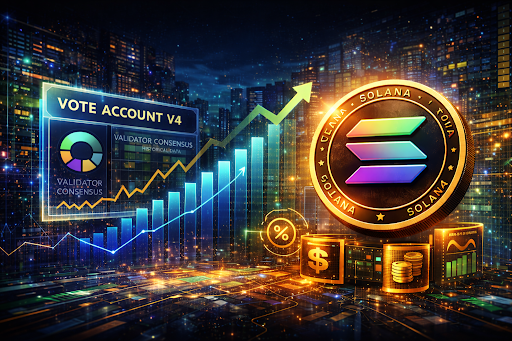
Solana is preparing for a significant protocol upgrade as part of its 2025–2026 roadmap. At the center of this update is Vote Account V4, a redesign of how validator vote accounts function on the network.
While it may sound technical at first glance, this upgrade carries meaningful implications for validators, staking participants, and the long-term structure of Solana’s proof-of-stake system.
Here’s what you need to know.
What Is Vote Account V4?
Vote accounts are a core component of Solana’s consensus mechanism. Validators use vote accounts to:
- Submit votes on blocks
- Record participation in consensus
- Earn staking rewards
- Manage commission structures
The Vote Account V4 upgrade introduces a redesigned framework for how vote account data is stored and managed.
The goal? Greater efficiency, flexibility, and long-term scalability.
Why Is Solana Upgrading Vote Accounts?
As Solana continues scaling in transaction volume and validator participation, legacy structures can create friction.
Vote Account V4 is designed to:
- Optimize how historical voting data is stored
- Reduce inefficiencies in account state management
- Improve validator commission configuration
- Lay groundwork for future block revenue distribution models
This upgrade is part of Solana’s broader effort to refine infrastructure rather than simply increase speed.
What Changes for Solana Validators?
1. Improved Data Storage Efficiency
Vote Account V4 redesigns how historical vote data is recorded.
For validators, this can mean:
- Cleaner account state management
- Reduced complexity in tracking vote history
- More scalable infrastructure as the network grows
Efficiency at the protocol level helps reduce long-term technical overhead.
- More Flexible Commission Settings
Validator commissions are a critical part of staking economics. The upgrade introduces more flexible commission configuration options.
This may allow validators to:
- Adjust commission models more efficiently
- Implement dynamic fee structures in the future
- Align incentives with delegators more effectively
Greater flexibility could strengthen competition among validators while benefiting stakers.
- Foundation for Block Revenue Distribution
One of the most forward-looking aspects of Vote Account V4 is its role in enabling future block revenue distribution features.
As Solana evolves, revenue sources beyond traditional inflation rewards may become more relevant. By restructuring vote accounts now, developers are preparing the network for more advanced economic models later.
This signals long-term strategic planning rather than short-term patchwork upgrades.
Why This Matters for the Solana Network
Protocol upgrades like Vote Account V4 may not grab headlines the way price rallies do, but they are essential for sustainable growth.
This update supports:
- Stronger validator infrastructure
- Improved staking economics
- Better long-term scalability
- Future revenue innovation
In proof-of-stake networks, validator health directly impacts security. A more efficient vote account structure strengthens the backbone of the entire system.
How Vote Account V4 Fits Into Solana’s 2025–2026 Roadmap
Vote Account V4 is part of a broader wave of Solana protocol enhancements aimed at:
- Increasing reliability
- Enhancing decentralization
- Improving consensus performance
- Supporting institutional-grade infrastructure
Rather than focusing solely on raw speed, Solana’s development roadmap appears to be shifting toward deeper structural improvements.
For validators, that means preparing for a more sophisticated and potentially more competitive ecosystem.
Potential Impact on SOL Stakers
Although Vote Account V4 is primarily validator-focused, stakers could indirectly benefit from:
- More transparent commission management
- Increased validator efficiency
- Potential long-term improvements in reward distribution
Healthy validator operations contribute to network security — and security supports long-term token value.
Risks and Considerations
As with any protocol upgrade, there are factors to monitor:
- Transition timelines
- Validator adoption rates
- Potential short-term technical adjustments
- Coordination between ecosystem participants
However, Solana’s phased rollout process typically involves testing on devnet and testnet before mainnet deployment, reducing upgrade risk.
Final Thoughts
The upcoming Vote Account V4 upgrade represents more than a technical adjustment — it reflects Solana’s continued evolution toward a more mature, scalable, and economically flexible blockchain.
For validators, it offers improved efficiency and future revenue possibilities.
For stakers, it strengthens network stability.
For the broader ecosystem, it signals long-term commitment to infrastructure refinement.
While market cycles come and go, foundational protocol upgrades like Vote Account V4 often play a larger role in shaping a blockchain’s future than short-term price movements.
Solana’s next chapter appears to be focused not just on speed — but on sustainable architecture.