For years, Web3 gaming has promised to revolutionize the $200+ billion global gaming industry. Yet despite waves of hype, most blockchain games struggled to reach mainstream players. High fees, slow networks, and clunky user experiences kept adoption limited.
But in 2026, something feels different.
Solana gaming projects are exploding in activity, funding, and user growth — and many believe this could be the moment Web3 gaming finally takes off.
So what’s changed? And why is Solana at the center of this new momentum?
Let’s break it down.
Why Solana Is Becoming the Go-To Blockchain for Gaming
The success of any blockchain game depends heavily on infrastructure. Gamers expect instant transactions, low costs, and smooth performance. Historically, many blockchains simply couldn’t deliver that experience.
Solana solves several of these problems:
- Ultra-low transaction fees
- High-speed processing (thousands of TPS)
- Fast finality
- Scalable infrastructure for mass adoption
For developers building immersive multiplayer games, these factors matter. Microtransactions, NFT minting, in-game asset trading, and reward systems all require seamless backend performance. Solana’s architecture makes that possible.
As a result, more studios are choosing Solana over competing Layer-1 chains.
Solana Gaming Projects See Surge in 2026
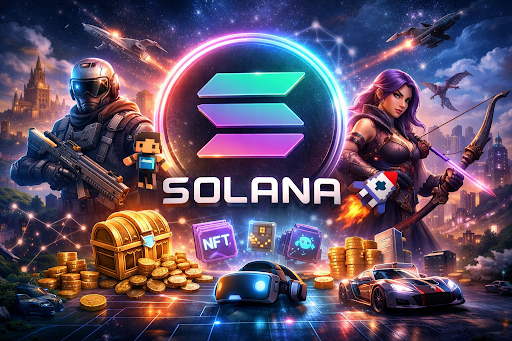
This year alone, dozens of new Solana blockchain games have launched or announced major funding rounds. From competitive shooters and MMORPGs to strategy and mobile-first games, the diversity of projects is expanding rapidly.
Key trends driving growth:
AAA-Quality Development
Unlike early play-to-earn experiments, new Solana NFT games are focusing on gameplay first. Studios are hiring experienced developers from traditional gaming backgrounds to build titles that can compete with mainstream releases.
Improved Tokenomics
Early Web3 gaming models often collapsed due to unsustainable reward structures. In 2026, play-to-earn Solana models are more balanced, emphasizing utility and long-term ecosystem growth instead of short-term speculation.
Strong Ecosystem Support
The Solana ecosystem has matured. Better wallets, streamlined onboarding, and improved developer tooling have lowered the barrier for both players and builders.
Is Web3 Gaming Finally Going Mainstream?
The biggest question remains: Is this the breakout moment?
Several indicators suggest momentum is real:
- Rising daily active users across Solana gaming platforms
- Increased venture capital funding into blockchain gaming 2026
- Growth in NFT marketplace volume tied to in-game assets
- Expanding partnerships between gaming studios and crypto infrastructure providers
More importantly, user experience is improving. Players can now enter many Solana gaming projects without deep crypto knowledge. Simplified wallet creation and embedded payment solutions reduce friction.
That’s critical for mainstream adoption.
The Role of NFTs and Digital Ownership
One of the strongest value propositions of Web3 gaming is digital ownership. In traditional games, players spend money on skins and items they don’t truly own. Blockchain gaming changes that dynamic.
In Solana NFT games:
- Players own their in-game assets
- Items can be traded on open marketplaces
- Cross-game asset interoperability is being explored
- Rare items can appreciate in value
This ownership model continues to attract both gamers and collectors.
Solana vs Other Gaming Blockchains
While Ethereum still dominates DeFi and NFT markets, gaming demands different performance standards. Competing chains have entered the race, but Solana’s combination of speed, cost efficiency, and ecosystem growth gives it a strong advantage.
In 2026, the Layer-1 battle increasingly includes gaming as a core metric — and Solana appears to be gaining ground.
Challenges Still Ahead
Despite the surge, risks remain.
- Market volatility can impact in-game token economies
- Regulatory clarity around crypto gaming is still evolving
- Some players remain skeptical of blockchain integration
However, compared to previous cycles, the infrastructure and developer maturity are significantly stronger.
What This Means for SOL Price and the Ecosystem
The growth of Solana gaming projects doesn’t just impact gamers — it affects the broader crypto gaming ecosystem.
More games mean:
- Higher on-chain activity
- Increased demand for SOL for transaction fees
- More staking participation
- Greater long-term ecosystem stickiness
If Web3 gaming continues expanding, it could become one of the most powerful adoption drivers for the Solana blockchain.
Final Thoughts: Hype Cycle or Sustainable Growth?
Web3 gaming has been “almost ready” for years. But 2026 feels structurally different.
Solana gaming projects are no longer experiments — they’re full-scale productions backed by funding, experienced teams, and improved technology. The focus has shifted from speculation to playability.
Will every project succeed? Of course not.
But if even a handful of breakout titles capture mainstream attention, blockchain gaming 2026 could be remembered as the turning point.
And if that happens, Solana may very well be leading the charge.