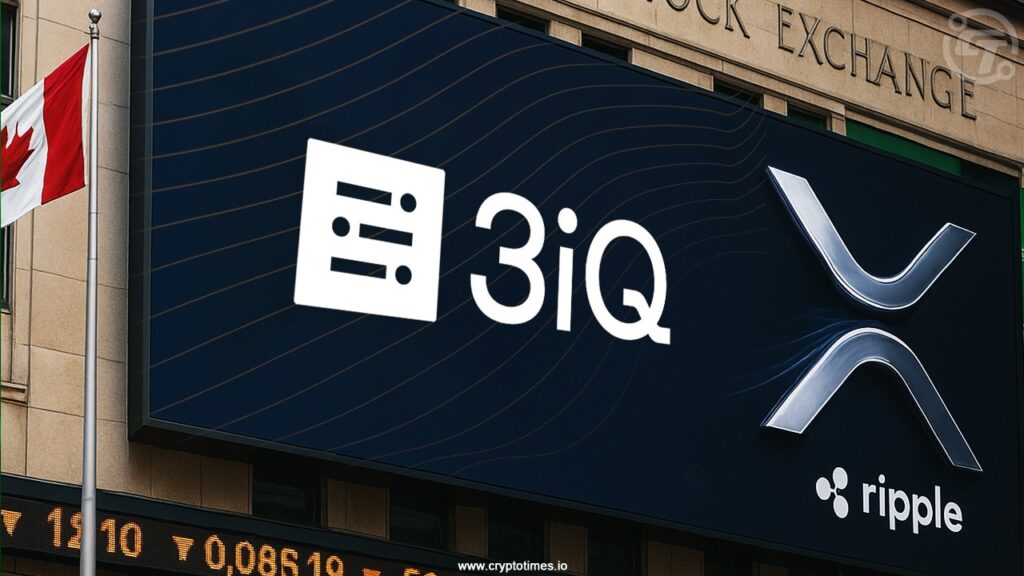
Ripple-Backed 3iQ Launches North America’s 1st XRP ETF on TSX

Ripple-Backed 3iQ Launches North America’s 1st XRP ETF on TSX

Canadian crypto asset manager 3iQ has rolled out North America’s first XRP ETF, now trading on the Toronto Stock Exchange under the tickers XRPQ and XRPQ.U. The move opens up a new regulated route for traditional investors to tap into XRP.

The fund offers direct exposure to XRP, the native token of the XRP Ledger, a blockchain known for powering fast, low-cost cross-border payments and liquidity flows.

What gives this launch additional weight is Ripple’s early investment in the ETF. The company, which developed XRP and the XRPL network, has thrown its support behind the product, a signal that it sees growing institutional demand for XRP exposure outside of crypto-native exchanges.

The ETF will hold 100% spot XRP. No derivatives. Assets will be sourced from regulated exchanges and OTC desks and will be kept in segregated cold wallets for added security.

To make the product attractive right out of the gate, 3iQ is offering a 0% management fee for the first six months. After that, regular fees will apply.

The ETF is available through registered Canadian accounts, with global access subject to local regulatory approvals.

“The launch of XRPQ marks another milestone in our mission to provide investors with convenient, cost-effective access to digital assets within a regulated framework,” said Pascal St-Jean, President and CEO of 3iQ. “Ripple Labs’ investment support reflects our shared leadership in advancing the digital asset space.”

Institutional Access to XRP, Finally

With this launch, 3iQ becomes the first asset manager in North America to bring regulated XRP exposure to public markets. That puts XRP, the third-largest digital asset by market cap, in the same arena as Bitcoin and Ethereum when it comes to ETF access.

XRP is built for speed and scale. It’s already being used for near-instant, low-cost global money transfers, with average settlement times of 3–5 seconds and fees that are a fraction of a cent. That utility is what’s kept it relevant even during regulatory hurdles.

XRP has seen a massive jump over the years. From around $0.02 in 2015, it now trades above $2.19, thanks to growing interest from institutions and better clarity on where it stands legally.

This is 3iQ’s second major crypto move this year. Earlier in 2025, it rolled out the Solana Staking ETF (SOLQ), which didn’t take long to become the world’s largest Solana ETF, now managing over $120 million.

XRPQ follows the same playbook. It’s built for long-term investors who want simple, regulated access to XRP, minus the hassle of managing wallets, keys, or navigating crypto platforms.

XRP is finally on the ETF map. With backing from Ripple, 3iQ’s launch of XRPQ adds one of crypto’s oldest and most-used assets to the list of tokens available through traditional finance infrastructure.

The fee-free launch window, institutional-grade custody, and regulated access make XRPQ one of the most accessible XRP investment vehicles on the market today.


Read the original article on coinmarketcap.com

The line between traditional finance and crypto just got a lot thinner. Western Union — one of the most recognizable names in global money transfers — is officially moving into

Solana traded at $87.44 on May 6, 2026 — a brutal 70% below its January 2025 all-time high of $295.90, despite the long-awaited spot ETF approval that was supposed to

Crypto markets are obsessed with price, but sometimes, the biggest opportunities appear when price and fundamentals stop moving together. That’s exactly what’s happening with Solana right now. While SOL continues

For years, crypto’s biggest battle was about speculation, now, it’s about infrastructure. And at the center of that fight sits one asset class quietly reshaping global finance: stablecoins. Governments are

Crypto markets don’t usually announce major shifts loudly. They whisper first—through capital flows, quiet deals, and strategic positioning. This week, one of those signals emerged: a $200 million equity program

For weeks, Solana has been stuck in a tight range—quiet, controlled, almost boring. But in crypto, silence often comes before the move. Right now, SOL is pressing against a critical

Solana has been here before—quietly consolidating while the rest of the market chases louder narratives. But this time feels different. While retail attention drifts toward memecoins and short-term pumps, analysts

For years, crypto has promised to disrupt global payments—but adoption has mostly lived in speculation, not infrastructure. That may be changing. Western Union, a century-old payments giant known for cross-border

For years, Ethereum has been the default answer. If you were building in crypto, investing in smart contracts, or betting on DeFi—ETH was the safe choice. The dominant ecosystem. The

Something is changing in how the market is talking about Solana. Not long ago, SOL was seen as a high-speed alternative—a promising but volatile ecosystem trying to prove itself. Now,

  • solana
  • Solana
    (SOL)
  • Price
    $92.39
  • Market Cap
    $53.35 B
# NamePriceChanges 24H Market CapPrice Graph (7D)

About Solana

  • Solana is a highly functional open source project that banks on blockchain technology’s permissionless nature to provide decentralized finance (DeFi) solutions. While the idea and initial work on the project began in 2017, Solana was officially launched in March 2020 by the Solana Foundation with headquarters in Geneva, Switzerland.

  • To learn more about this project, check out our deep dive of Solana.
  • The Solana protocol is designed to facilitate decentralized app (DApp) creation. It aims to improve scalability by introducing a proof-of-history (PoH) consensus combined with the underlying proof-of-stake (PoS) consensus of the blockchain.
Powered by TradingView

Real-Time Forecasts, Daily Price Targets, and Market Trends for the Fastest Blockchain in Crypto.