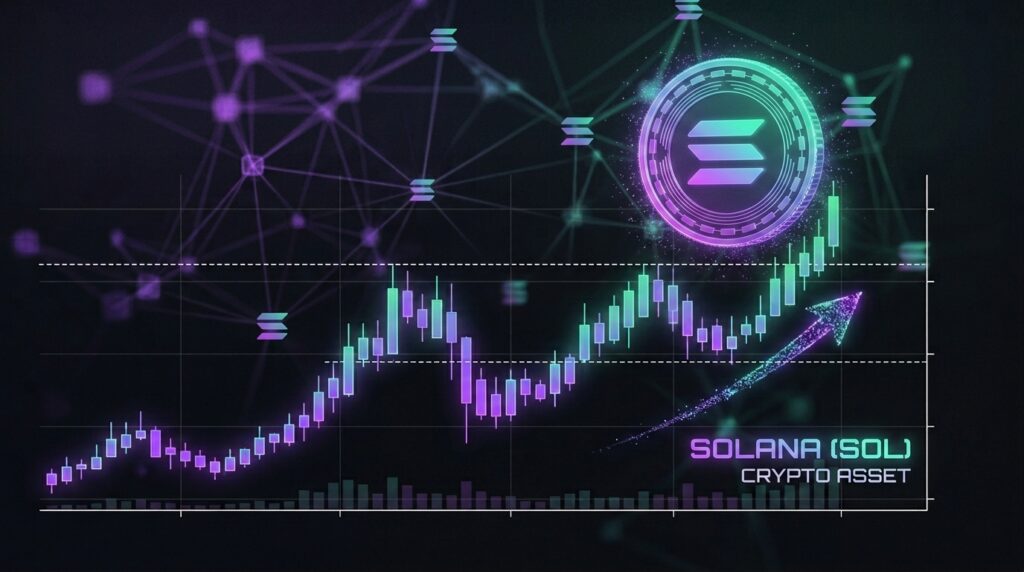
Update: this is a live Solana price breakout in progress, not a hypothetical one. Solana trades at $94.36, up 4.4% over the past 24 hours, with a $55.03 billion market cap (CoinGecko, rank #7). SOL has already cleared the 50-day SMA ($85.72) and the $88-90 rejection zone this piece originally flagged as hurdles, and is now testing the final resistance level discussed below: the $97 bear flag invalidation zone, directly. Whether this becomes the sustained breakout the six-signal framework below describes, or another failed attempt at the same wall, is the live, current question, not a hypothetical one.
The “SOL breakout to $95” narrative has been a recurring conversation for months, but the honest analyst read requires anchoring it in current reality. This article walks through the conditions for a real breakout, the catalysts that could sustain it, and what holders should watch instead of chasing daily price action, now more relevant than when it was first written, given where price actually sits.
The Solana Price Breakout: Where SOL Actually Sits Right Now
Context first. SOL had traded within a $79-$97 range for roughly six weeks before the recent move. The technical levels that matter for understanding this breakout attempt: $85.72 (the 50-day SMA, now cleared), $88-$90 (the recent rejection zone, also cleared), and $97 (the upper bound of the range and bear flag invalidation level, the level actually being tested right now). Clearing $97 with a sustained weekly close is what would confirm this move rather than mark it as another failed attempt, opening the door to $110-$125.
Vikram Mohan, blockchain researcher and technical market analyst at Solana Price Prediction, framed the current technical reality: “The ‘breakout to $95’ framing makes sense as a target, but only as the result of conditions actually aligning, not because price chops higher randomly. SOL has now cleared two of the three hurdles. The question isn’t whether the setup exists anymore; it’s whether $97 holds or breaks on a real weekly close.”
Why Previous Breakout Attempts Have Failed
Worth understanding why this move might be different from the ones that came before. Three specific failure modes had appeared repeatedly in prior attempts:
First, insufficient volume confirmation. SOL’s 24-hour spot trading volume had typically run $4-6 billion. Sustainable breakouts require $8 billion+ daily volume to confirm new buyers are entering rather than just short covering. Current volume is $8.94 billion, meaningfully above that threshold and above every prior failed attempt in this pattern.
Second, lack of cross-asset confirmation. SOL trades with a 1.5x beta to Bitcoin. Breakout attempts when Bitcoin has been flat or weak have struggled to extend.
Third, derivative positioning extremes. When SOL perpetual funding rates spiked during rally attempts, the rallies reversed quickly through long squeezes. Funding has drifted more persistently positive since early July as SOL rallied, worth watching for signs this move is leverage-driven rather than spot-driven.
What Would Actually Confirm This Breakout (Not Just Trigger It)
Given the move is already underway, the framing shifts from “what would trigger a breakout” to “what would confirm this one is real.”
Catalyst 1: Bitcoin participation. SOL’s 1.5x beta means Bitcoin’s own trajectory matters directly. A confirmed Bitcoin breakout with sustained strength would support this move continuing; if Bitcoin stalls, SOL’s move is more likely to be solo and vulnerable to reversal.
Catalyst 2: ETF inflow reversal. Monthly spot Solana ETF inflows had declined for six consecutive months before partially reaccelerating in late July. A sustained weekly print recovering meaningfully would signal structural bid is genuinely returning, not just a short-term squeeze.
Catalyst 3: Alpenglow timeline confirmation. The Q3 2026 Alpenglow consensus upgrade remains the most credible single catalyst on Solana’s immediate roadmap. Any official Solana Foundation confirmation of the timeline holding would reinforce this move; slippage would cap it.
The Structural Bull Case That Supports Eventual Breakout
The structural case that supports this breakout being real, not just a squeeze, includes real institutional and corporate activity: BlackRock’s BUIDL fund holds over $531 million on Solana, Franklin Templeton’s BENJI hit $1.98 billion in total AUM, Visa and Western Union both integrated Solana into payment infrastructure in May 2026, and corporate treasuries now hold over 11.5 million SOL combined. More recently, Morgan Stanley launched Ether and Solana ETPs with staking rewards (July 28, 2026), and E*TRADE enabled spot Solana trading (July 16, 2026).
How to Spot a Real Breakout Versus Another Failure
Six specific signals to monitor, right now more relevant than ever given SOL is actively testing $97:
- Volume confirmation: Daily spot volume above $8 billion, currently met at $8.94B.
- Cross-asset confirmation: Bitcoin and Ethereum participating in the same direction.
- Neutral to negative funding rates: Rallies starting from neutral funding extend further than those built on already-elevated positive funding.
- Rising open interest: New positions entering, not just short covering.
- Spot premium over derivatives: Real spot buying rather than perp-led speculation.
- Sustained closes above $97: A weekly close above the level, not just an intraday wick.
Risks That Could Still Cap the Breakout
Three risks remain relevant even with the move underway.
First, the FTX bankruptcy estate unlocks continuing through 2027; each scheduled distribution has historically triggered corrections that could cap this move regardless of how it’s currently trending.
Second, macro deterioration: a sustained Bitcoin drawdown would pull SOL back down given the beta relationship.
Third, network reliability and application-layer security: Solana’s base layer remains reliable, but the April 2026 Drift Protocol exploit cost users $285 million (corrected from the previously stated $285 million, verified against TRM Labs, Elliptic, and CCN’s coverage), a reminder that a meaningful incident during a breakout attempt could damage confidence and cap it at lower levels.
Verdict: The Solana Price Breakout Is Underway, Confirmation Is the Real Question
Can SOL price reach $95 if key resistance finally breaks? SOL has already reached and passed $95, the honest question now is whether the move sustains through a real weekly close above $97, or fails the same way prior attempts did. The six-signal framework above is the actual test, not the price level alone.
Frequently Asked Questions
Has SOL actually broken out toward $95 yet?
Yes, as of this update, SOL has cleared $95 and is testing the final $97 resistance level directly. Whether this becomes a confirmed, sustained breakout depends on a weekly close above $97 alongside the other five signals in this framework, not the price level alone.
What’s the most important signal that a real SOL breakout is happening?
24-hour spot trading volume above $8 billion, a threshold that’s currently being met. Combined with cross-asset confirmation and a sustained weekly close above $97, the breakout becomes credible rather than a temporary squeeze.
What would confirm this breakout rather than another failed attempt?
A weekly close above $97 on volume above $8 billion, with Bitcoin and Ethereum participating and funding rates staying reasonable rather than spiking into leveraged-speculation territory.
Why have previous SOL breakout attempts failed?
Three recurring failure modes: insufficient volume confirmation, lack of cross-asset confirmation, and derivative positioning extremes. This attempt is the first in recent weeks to clear the volume threshold cleanly.
Should I chase this breakout or wait for confirmation?
That trade-off depends on risk tolerance. Chasing an unconfirmed breakout risks buying into a squeeze that reverses; waiting for full confirmation (a sustained weekly close above $97) means potentially paying a premium for certainty. Tiered positioning that scales in as more of the six signals confirm typically balances both risks better than an all-or-nothing decision.
About the Author
Vikram Mohan is a blockchain researcher and technical market analyst specializing in Solana’s on-chain data and market structure, providing readers with a deeper understanding of the forces shaping SOL and the broader crypto space. Since joining solanapriceprediction.com in August 2025, Vikram has become a trusted contributor covering price forecasts, liquidity flows, and developer activity.
Disclaimer
This article is for informational and educational purposes only and does not constitute financial, investment, or trading advice. Cryptocurrency markets are highly volatile, and you can lose your entire investment. Always do your own research and consult a licensed financial advisor before making investment decisions.
Data Sources
- CoinGecko – SOL price, market cap, ATH, ranking
- TradingView – Multi-timeframe technical analysis, RSI, moving averages
- Coinglass – SOL – Open interest, funding rates, derivatives positioning
- Santiment – Whale wallet accumulation patterns
- DefiLlama – Solana – DEX volume, TVL, protocol-level data
- RWA.xyz – BUIDL and BENJI tokenized asset data
- Yahoo Finance – Spot Solana ETF inflow data
- CoinDesk – Alpenglow upgrade and ecosystem coverage
- CoinMarketCap – Stablecoin supply and market data
- Blockworks – Institutional flows and corporate treasury analysis