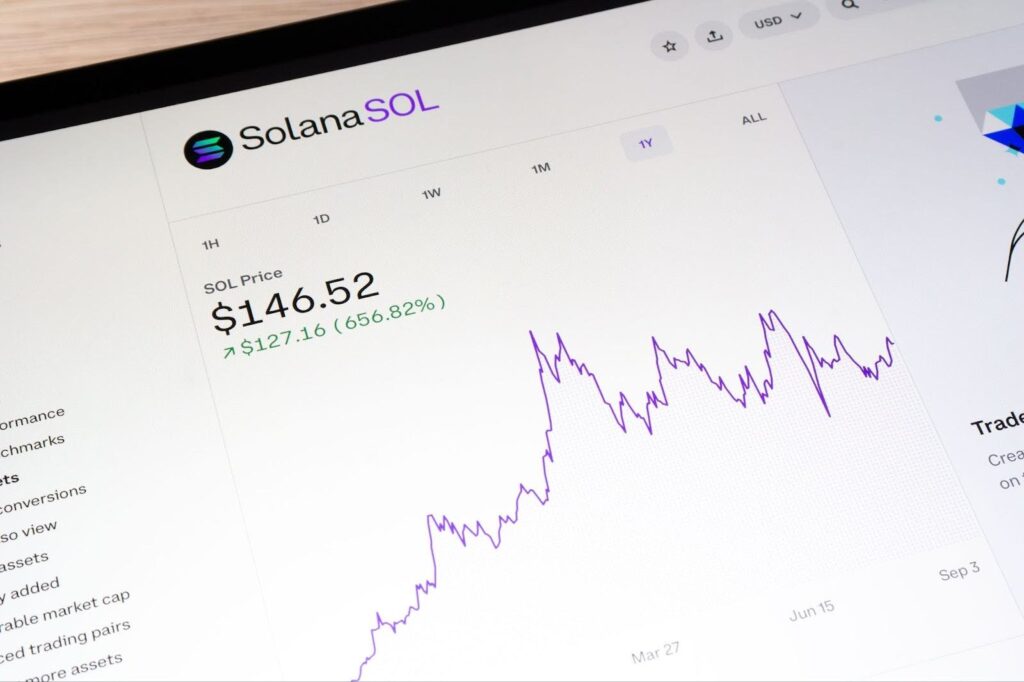
Solana trades at $84.36 on May 18, 2026, with a $48.74 billion market cap (CoinGecko, rank #7) — still 71% below its January 2025 all-time high of $295.83. The honest read on whether SOL can break the $200 resistance level requires anchoring the question in reality: from current levels, SOL needs a 137% rally just to retest $200, and the immediate resistance levels traders are watching sit at $97, then $110-$120, with the psychological $150 level above that. As a result, $200 is no longer a near-term technical question — it’s a medium-term thesis target requiring specific catalysts to play out over the next 12-18 months. Here’s the honest analyst breakdown of the actual path from $84.36 to $200, what specifically needs to happen, and what the realistic timeline looks like.
This article is for SOL holders looking past the daily noise to understand what conditions would need to align for SOL to credibly retest $200. By contrast to clickbait “SOL to $200 imminent” content, this piece walks through the verifiable data, the specific catalysts, and the probability framework that determines whether $200 happens in late 2026, mid-2027, or later. Anchored to hard numbers, not narrative.
The Math: What $200 SOL Actually Requires
From $84.36 to $200 represents a 137% rally — significant but well within SOL’s historical volatility range. By contrast, SOL ran from $8 in late 2022 to $295.83 in January 2025, a 36x move over 26 months. Replicating even a fraction of that magnitude from current levels puts $200 in clear view. Therefore, the question isn’t whether the math works — it’s what specific conditions need to align for the move to happen and on what timeline.
The market cap implications matter. At $200 with current circulating supply of approximately 576.46 million SOL, the market cap reaches $115.3 billion. By 2027, circulating supply will sit closer to 590-600 million SOL after inflation, meaning the market cap requirement at $200 nudges higher to $118-120 billion. For context, that’s roughly 40% of Ethereum’s current ~$290B market cap — meaningful but not requiring SOL to flip ETH. As a result, $200 is a credible target in any cycle where Solana captures meaningful additional institutional and retail allocation.
Selena Rodriguez, Senior Crypto Analyst at Solana Price Prediction, framed the realistic timeline: “$200 is the most realistic intermediate target for SOL — meaningful upside without requiring magical thinking like $500 or $1,000. The honest read is that $200 likely lands in mid-to-late 2027 if Alpenglow ships, ETF inflows recover, and Bitcoin enters sustained expansion. Anyone forecasting $200 in 2026 needs to explain what’s different about the next 7 months versus the last 5.”
The Specific Path From $84 to $200
Working backward from $200, the path SOL needs to walk through is well-defined by chart levels and historical resistance zones. Each step has measurable thresholds rather than aspirational wishes.
Step 1: Hold support at $79. The lower bound of SOL’s current range has been tested three times since March 2026 without breaking. Holding $79 keeps the bullish setup intact.
Step 2: Reclaim $97 on volume. The upper bound of the current range and the bear flag invalidation level. A confirmed weekly close above $97 with $8 billion+ in 24-hour spot volume opens the door to $110-$125 quickly.
Step 3: Push through $110-$120. The next major resistance zone, including the 200-day SMA at $118.65 — currently a major bearish overhang. Clearing this zone neutralizes the death cross pattern that’s defined SOL’s chart since early 2026.
Step 4: Break the psychological $150 level. Historically a major SOL battleground. Sustained trading above $150 typically signals a regime change from cautious to optimistic in market sentiment.
Step 5: Test $200 resistance. The level the original article asked about, now framed as the destination rather than the immediate question. Reaching this level requires all four prior steps plus broader macro support.
Three Catalysts Required for the $200 Path
The technical path matters, but catalysts drive the actual move. Three specific catalysts could push SOL meaningfully closer to $200 over the next 12-18 months.
Catalyst 1: Alpenglow Q3 2026 mainnet launch. The consensus upgrade slashing block finality from approximately 12 seconds to roughly 150 milliseconds is the most credible single catalyst on Solana’s immediate roadmap. A successful Alpenglow launch would unlock application categories the current consensus design can’t support — HFT, real-time gaming, point-of-sale payments — and would likely trigger fresh ETF inflows and institutional repricing within 4-8 weeks of mainnet.
Catalyst 2: ETF inflow reversal. Monthly spot Solana ETF inflows declined for six consecutive months to $39.93 million in April 2026 — down from $200M+ months in late 2025. A single quarter of inflows reaccelerating above $100M monthly would shift sentiment meaningfully. Furthermore, any major issuer announcement (BlackRock, Fidelity, Vanguard) increasing Solana exposure would accelerate the timeline. Cumulative inflows already sit at $974.68 million since the October 2025 ETF launch — the channel exists, the flow just needs to recover.
Catalyst 3: Bitcoin entering sustained expansion phase. SOL trades with a 1.5x beta to Bitcoin. A 30% BTC rally typically produces a 45% SOL move on beta alone — and combined with Solana-specific catalysts, that math compounds quickly. By contrast, if Bitcoin remains range-bound through 2026, SOL likely follows a similar consolidation pattern regardless of fundamentals improvement.
The TradFi Adoption Pattern Supporting $200
The institutional adoption pattern that emerged through 2025 and 2026 directly strengthens the structural case for $200 SOL. BlackRock’s BUIDL fund holds over $531 million on Solana as part of a $2.85B total AUM. Franklin Templeton’s BENJI hit $1.98 billion in total AUM with Solana as one of eight supported chains. Visa added Solana to its multi-chain stablecoin settlement network on May 3, 2026 — annualized stablecoin settlement volume reached $7 billion. Western Union deployed USDPT via Anchorage Digital Bank in early May 2026 across 200+ countries. J.P. Morgan arranged U.S. commercial paper issuance for Galaxy Digital on Solana.
Furthermore, corporate treasuries now hold over 11.5 million SOL combined. Forward Industries (NASDAQ: FORD) leads with 6.9 million SOL. DeFi Development Corp (NASDAQ: DFDV) announced a $200 million ATM equity facility on May 4, 2026 specifically to buy more SOL. Pantera Capital is reportedly seeking up to $1.25 billion for a dedicated “Solana Co.” treasury vehicle. As a result, the structural buy-side absorption from corporate balance sheets now rivals ETF flows in any given month — directly supporting the supply-side conditions required for $200 to print.
Realistic Timeline for $200
| Timeframe | Probability of $200 | What’s Required |
|---|---|---|
| End of 2026 | 10-15% | BTC breaks $150K, Alpenglow ships Q3, ETF inflows reaccelerate hard |
| Mid-2027 | 35-45% | Full bull cycle expansion, Alpenglow proven, TradFi adoption scales |
| End of 2027 | 50-60% | Continued institutional flow + corporate treasury accumulation |
| 2028 (post-halving) | 65-75% | Post-halving cycle expansion typically lifts altcoins |
The honest read places $200 most probably in the mid-to-late 2027 window, with end-of-2027 as the realistic base case and 2028 as the higher-probability backstop. By contrast, anyone forecasting $200 in 2026 needs all three catalysts to land in a compressed 7-month window — possible but well below 20% probability.
SOL Price Targets Through 2027
| Timeframe | Bear Case | Base Case | Bull Case |
|---|---|---|---|
| Short-term (1–3 months) | $67 | $85–$110 | $125 |
| Mid-term (6–12 months) | $75 | $130 | $185 |
| Long-term (2026–2027) | $90 | $220 | $340 |
The bull case for end-of-2027 reaches $340 — well above $200 — confirming that $200 sits in the credible mid-range of the long-term outlook rather than at the aggressive bull case extreme. As a result, $200 is achievable in scenarios significantly less optimistic than the full bull case requires.
Current Technical Setup
The 14-day RSI on the daily chart sits in the mid-40s — neutral, leaning weak. The weekly RSI dropped to 29.7 earlier in 2026, technically oversold. The 50-day SMA at $85.72 has been a battleground level through May 2026. The 200-day SMA at $118.65 remains the major bullish target, while a “death cross” pattern remains in effect from earlier in 2026. Resistance to clear: $97, then $110–$120, with the psychological $150 level above. Support stacks at $83, $79, and $75.
For the $200 path: SOL needs to hold above $79 in the near term, reclaim $97 within 1-3 months, push through $110-$120 by H2 2026, retest $150 in Q1 2027, then break through the $295 January 2025 ATH by H2 2027 before $200 becomes a credible 12-month target. Each milestone has clear conditions attached — not a moon scenario but a stepwise framework with measurable thresholds.
Risks That Could Cap SOL Well Below $200
Three risks deserve real weight. First, FTX bankruptcy estate unlocks continue through 2027. The estate still holds tens of millions of SOL, with scheduled distributions triggering double-digit corrections historically. Therefore, every quarter of strong fundamentals is partially offset by known supply shocks — meaning corporate treasury accumulation needs to outpace these scheduled releases for the float to tighten meaningfully.
Second, Ethereum L2 scaling closing the cost gap. Vitalik’s roadmap targeting “1 million TPS” through rollup parallelization could narrow Solana’s structural fee advantage by 2028. By contrast, Solana’s current 5,500+ TPS at $0.00025 per transaction remains structurally cheaper, but the gap is narrowing. If Ethereum’s scaling roadmap ships materially faster than expected, Solana’s market share thesis weakens.
Third, macro deterioration. SOL’s 1.5x beta to Bitcoin means a sustained BTC drawdown of 30%+ pushes SOL toward $48-$60 territory and resets the $200 timeline by 12-18 months. Furthermore, regulatory shifts around stablecoins, tokenized securities, or memecoins could meaningfully slow Solana-specific catalysts.
Verdict: $200 Is Credible — But in 2027, Not 2026
Can Solana break above $200 resistance? Yes — but the honest timeline is mid-to-late 2027, not end of 2026. The base case for end-of-2027 reaches $220 (slightly above $200), with the aggressive case extending to $340. By contrast, 2026 sits at 10-15% probability for a clean $200 break given the compressed timeline and required catalyst alignment. Anyone treating $200 as a near-term question is fighting the math; anyone treating it as a 12-24 month thesis target is reading the data correctly.
For SOL holders, the practical implication is that the current $79-$95 accumulation range represents the optimal positioning zone for an asset with credible 2027 upside to $220. By contrast, waiting for chart confirmation of momentum toward $200 means buying in at $150 or higher — a meaningfully worse risk-reward setup. Ultimately, the smarter framing is treating $200 as a target for the next bull cycle rather than the current consolidation, and accumulating in the current range with the catalyst awareness that determines when the timeline shifts from “credible” to “imminent.”
Frequently Asked Questions
What’s the current SOL price and how far is it from $200?
SOL trades at $84.36 on May 18, 2026, meaning $200 requires a 137% rally. By contrast, SOL has historically delivered larger moves — from $8 in late 2022 to $295.83 in January 2025 (36x over 26 months). The math is achievable; the question is timeline and probability.
When could SOL realistically break $200?
Mid-to-late 2027 in the base case (35-45% probability), with end-of-2027 reaching 50-60% probability if catalysts align. By contrast, 2026 sits at 10-15% probability requiring Alpenglow shipping, ETF inflow recovery, and Bitcoin entering sustained expansion in a compressed 7-month window.
What’s the biggest catalyst for SOL reaching $200?
The Alpenglow consensus upgrade targeting Q3 2026 mainnet. Slashing finality from ~12 seconds to ~150 milliseconds is a structural category shift that would likely trigger fresh ETF inflows and institutional repricing within 4-8 weeks. Combined with continued TradFi adoption (Visa, Western Union, BlackRock BUIDL) and corporate treasury accumulation (11.5M+ SOL combined), Alpenglow is the most credible single trigger.
What’s the technical path SOL needs to walk to reach $200?
Five steps with measurable thresholds: (1) Hold $79 support, (2) Reclaim $97 with $8B+ daily volume, (3) Push through $110-$120 including the 200-day SMA at $118.65, (4) Break the psychological $150 level, (5) Test $200 resistance. Each milestone has clear conditions — not a moon scenario but a stepwise framework.
What’s the biggest risk that could prevent SOL from reaching $200?
Continued macro weakness combined with FTX estate unlocks. SOL’s 1.5x beta to Bitcoin means a sustained BTC drawdown of 30%+ pushes SOL toward $48-$60 and resets the $200 timeline by 12-18 months. Combined with the tens of millions of SOL still held by the FTX bankruptcy estate (with distributions continuing through 2027), even strong fundamentals can be partially offset by known supply shocks.
About the Author
Selena Rodriguez is a Senior Crypto Analyst at Solana Price Prediction with over a decade covering Layer-1 protocols, consumer-crypto adoption, and long-horizon market thesis development. Her research focuses on translating multi-cycle catalysts and institutional adoption signals into actionable scenarios for both retail and institutional readers.
Disclaimer
This article is for informational and educational purposes only and does not constitute financial, investment, or trading advice. Cryptocurrency markets are highly volatile and you can lose your entire investment. Always do your own research and consult a licensed financial advisor before making investment decisions.
Data Sources
CoinGecko – SOL price, market cap, ATH, ranking
CoinMarketCap – Stablecoin supply, RWA metrics, daily transactions
TradingView – Multi-timeframe technical analysis, RSI, moving averages
DefiLlama – Solana – DEX volume, TVL, protocol-level data
Token Terminal – Monthly token holder and protocol revenue data
Santiment – On-chain accumulation patterns and whale activity
RWA.xyz – BUIDL and BENJI tokenized asset data
Yahoo Finance – Spot Solana ETF inflow data
CoinDesk – Alpenglow upgrade and ecosystem coverage
Blockworks – Institutional flows and corporate treasury analysis